

Subtextually speaking ...
No subtext about this announcement: One seat left in my weekly workshop group! Story Lab could be your weekly writing haven in a friendly, coach-led peer group. Grab the last seat now—it'll go fast.
When writers ask me how to make their scenes feel more tense without adding more conflict, I know we’re about to talk about subtext. It’s the space between what characters say and what they mean—and in fiction, it’s often where the real story lives.
Subtext operates beneath dialogue and action, creating the emotional undertow that keeps readers turning pages. Your detective doesn’t need to announce she suspects her partner. Your lovers don’t need to declare their feelings. The best moments in thrillers, fantasy, and romance happen when characters don’t say what’s really going on, when the real meaning pulses just beneath the surface.
This week’s first article explores subtext through the lens of horror, but the techniques work across all genres. Whether you’re writing a fantasy negotiation that’s really about power or a romance conversation that’s actually about fear, subtext is how you make readers feel the story instead of just reading it.
Story Lab: Last seat up for grabs
The last seat is up for grabs for 2026 membership in Story Lab, my tiny, old-fashioned face-to-face writing group. Capped at just six members, Story Lab meets online every Wednesday for real conversation and hard work.
What we do in Story Lab:
Weekly live workshopping and instruction. This isn’t a video course—it’s face-to-face coaching with me on Google Meet every week. You’ll receive feedback on your work in progress while story and scene development techniques you’ll use throughout your writing career.
Small group with plenty of opportunity to be heard. Group size caps at six members. You’ll have space to contribute, ask questions, and get individualized attention.
Steady accountability through the complete manuscript life cycle. Over the year, we’ll move through the full arc of your book. Whether you’re drafting or revising, the weekly rhythm keeps you moving toward “The End.”
Coach-led feedback only—no peer critique. All analysis happens under professional guidance during group sessions. You’ll develop your critical eye by examining what works and what doesn’t, but never at the expense of another writer’s vulnerable early writing.
Three-month commitment, January through March 2026. Keep your seat, and we’ll be here all year long.
I coach a limited number of clients each year. This is your chance to take a giant step forward with a small group of other writers just like you. Get in touch before the seat is taken!
This week at The Writes of Fiction
Writing subtext
Using form without being formulaic
How not to pull your writing’s teeth
What you can learn from the openings of bestsellers
Writing subtext
You don’t have to tie every ribbon into a neat little bow. Trust your reader to follow shadows. This might mean ending a chapter on a gesture, not a resolution; letting a conversation trail off mid-thought; showing a reaction without the cause—until later.—Read more from Lindy Ryan at Jane Friedman.
More on writing that’s too obvious: One of the most common point of view errors I see is referring to a character with a name the viewpoint character wouldn’t naturally use—for example, a character thinking of her dad as “Mr. Bosch” rather than “Daddy” or even “my father.”
This can feel tricky when there’s a difference between what a character thinks (“Mommy”) and what they say to others (“my mom” or “my mother”). We all hold different frameworks in our heads for the people in our lives. Make sure you choose the one that makes sense for the viewpoint character and the context.—Read more at Are you overusing character names in your novel?
Using form without being formulaic
Countless songs are based on a formula of common chord progressions; dancers recombine the formula of body, energy, space, and time; artists recombine the seven elements of art—line, shape, form, space, value, color, and texture—to create seemingly infinite variations on the formula.
Formula isn’t a copout or a dirty word for artists; it’s our foundation. It’s why every writing teacher worth their salt will advise authors to learn the “rules” before they break them: You can’t create something “new” without understanding the elements and theories and systems that underlie your art form. We are all standing on the shoulders of those who came before us.—Read more from Tiffany Yates Martin at FoxPrint Editorial.
More on the “rules” of the road: Words and grammar are like traffic signs; they work because we agree what they mean. When you string them together without caring whether they say something different to readers than whatever you meant when you wrote them, you’re setting yourself up for a crash. And if you don’t know what other people accept them to mean in the first place—well, don’t be surprised if readers step off your ride long before it’s reached its destination.—Read more at Why story structure won’t squelch your creativity.
Don’t pull your story’s teeth
We’ve seen how maybes and possiblys can weaken the thinking, but there’s a different kind of weakening which happens when a writer is - paradoxically - trying to be more exact. I go on about how being specific and particular (scroll down a bit) is usually the best way to fire up the reader’s imagination, but there’s also the style of sentence which Stephen Pinker calls CYA - which (being better brought up than me) he says stands for ‘cover your anatomy’ - and sometimes ‘compulsive hedging’.
It’s the nervous kind of exactitude which must qualify everything, or explain everything, in case you’re caught out exaggerating or getting things ‘wrong’ - hence my sense that it’s particularly common in historical fiction and other stories resting on researched material.—Read more from Emma Darwin at This Itch of Writing.
More writing advice: Readers usually assume that the first character named in a scene is the viewpoint character. Positioning the viewpoint character in the opening has the added benefit of launching them into motion, doing or speaking or considering or noticing. Now viewpoint character has agency in driving the scene.
Also near the top of a scene, establish who else is present. Ideally, this should happen within the first page or so. You want to avoid the sort of confusion when some character pops off on the last page with a snarky observation, only readers didn’t even realize they were there. A glimpse of each character is sufficient, even a collective mention such as The others armed themselves with plastic forks and swarmed the defenseless box of cake on the counter.—Read more at Strategies for smooth scene openings.
What you can learn from bestsellers’ openings
But a tour is only as good as the guide, and usually within the first few minutes you can tell if you’re in good hands or not. One of my favorites is a hop-on,-hop-off trolley. Hate the guide? Hop off. Undecided? Stay a little longer. Love? Settle in.
Tours and novels are alike in that way. The sooner you demonstrate to the reader that they’re in good hands the better. That first line and first paragraph can signal to the reader whether or not they want to stay or hop off.—Read more from Karin Gillespie at Pitch Your Novel.
More on reading for writers: After a decade of coaching emerging fiction writers, I’ve discovered something crucial: The difference between aspiring writers and published authors often comes down to technique.
These books represent the essential craft foundation every serious fiction writer needs. I don’t recommend them lightly. Each title on this list has proven itself in my coaching practice, helping writers transform promising ideas into compelling manuscripts that connect with readers.
You’ll find no fluff here. These are the texts I return to again and again when working with clients who want to understand what makes stories work.—Read more at Recommended craft titles for fiction writers.
Fiction Fuel
Know thyself. Know thy book. Make decisions on its behalf as you write it. If it is too cerebral and you don’t like that, there are ways to fix it. Likewise, if you feel your book is too “easy” (too audience-aware, not deep enough, condescendingly simple): go ahead and write that book, if that’s the one you want to write. But be prepared, by Conroy, with reasonable expectations that you may not get critically lauded. And if that notion bothers you, well, you can dig into that feeling (“too audience-aware, not deep enough”) and see what it means to you, technically: how might you (you could ask yourself) make it deeper? What does “deeper” mean to you, anyway? How is it “not deep?” Why do you feel uncomfortable with your book’s current level of what we’re calling “audience-awareness?” Do you feel you’re pandering? What are you afraid of?—George Saunders
Happy Holidays from The Writes of Fiction. I’ll be away from regular updates for the rest of the month.
If you’re curious about Story Lab and the weekly win created by getting together with creative, congenial writing peers, please get in touch about details.
Onward,
Lisa
This is The Writes of Fiction, a slow-simmered concoction of old and new thinking about writing fiction—the bits I find most helpful to writers finding their way. I hope they help you too.
And here’s editorial assistant Tsuki with a holiday boop and a glimpse of her pajamas.
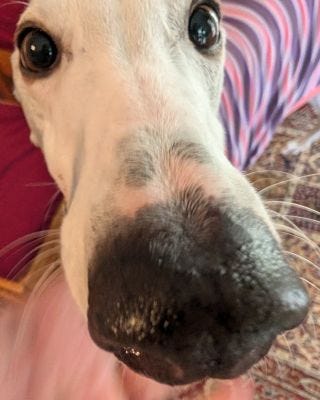
🐾 Support your #editorialassistants via Greyhound Adoption League of Texas.

If you enjoyed this week’s Writes of Fiction, consider buying me a tea. This week, I’m still pounding chai lattes for one or two more deadlines …

If you’re looking for consistent momentum and thoughtful feedback, this kind of weekly container makes all the difference.